If a retail forex trader opens a long trade on GBP-USD with a broker, they’re not really buying GB Pounds, are they? They’re just betting the broker’s GBP-USD price will rise? No currencies change hands.
Isn’t bitcoin similar for retail traders? We’re not actually buying Bitcoin when we “trade” with a “broker”? We’d need to use an exchange, to buy BTC?
If we were actually trading real currencies via a broker then we would need to have bank accounts to and from which those currencies would be credited/debited - just like when a company buys currencies from a bank.
What we trade are (usually) CFD’s which are agreements that track the price of the actual underlying instrument without any direct purchase/sale.
Bitcoin is exactly the same. If one wants to buy actual BTC then one needs to open a wallet somewhere to which the coinage is credited. You transactions are visible to everyone but only via your encrypted account “name”.
But we can also trade CFD’s and futures/options on BTC which, again, track the price of the actual underlying coinage. In my opinion, this is a much better and cheaper way to trade BTC if one is planning to trade actively and in the shorter term. Longer term investment is better in a wallet (I think).
I don’t consider Bitcoin a currency because it lacks intrinsic value and offline utility. We’re still not at the point where I can buy a gallon of milk or a gallon of gas with it and I have yet to see a grocery store with BTC price labels on their shelves.
Before I get jumped on with comments that our fiat currency doesn’t have intrinsic value because it’s no longer back by gold or other minerals. Coins are denominations of currency and are usually made of metals. Coins such as the U.S. Nickel at some point contained a higher value of nickel than the face value of the coin.
Face value aside, in the event of a SHTF moment where there is no internet or electricity and I needed to use paper currency as kindling to start a fire or melt down coins to make a projectile for a slingshot in order to hunt for food, the fiat currency would have intrinsic real world value. If I relied on using Bitcoin for survival, I would probably freeze or starve. I lean towards prepping and survival, so the value test is simply if the lights go out, will it still have any utility. I always have cash on me and this premise is dependent on that part since any electronic payment system (fiat or crypto) would fail in this scenario.
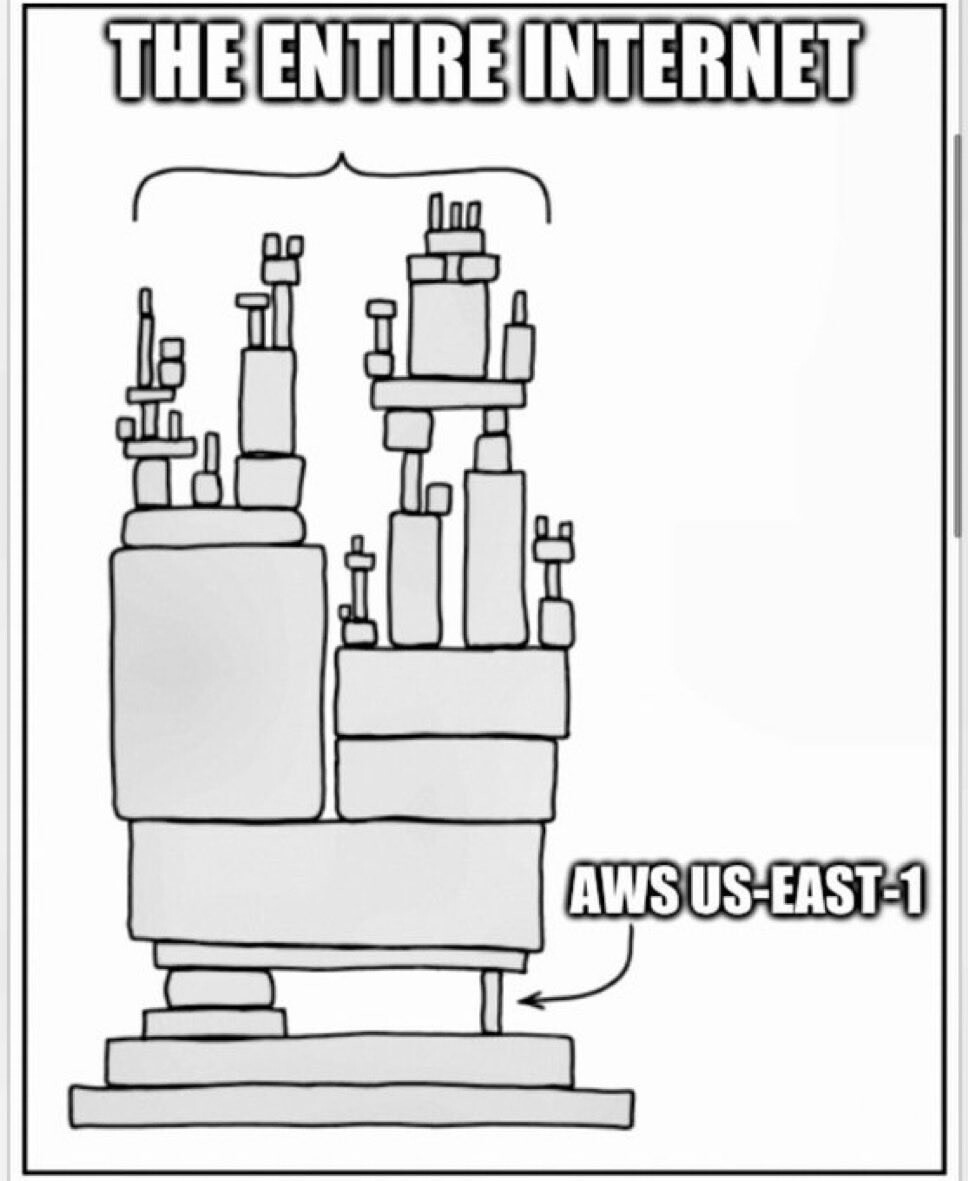
The recent AWS outage reminded me of just how fragile the internet infrastructure can be.
Any fiat currency or crypto only has value as a medium of exchange or a store of value because enough people believe that there will be enough other people willing to accept that value proposition in the future.
Thanks for the detailed contribution @MartialChartsFX . I really appreciate it.
A few comments:
Yes, I think we are a long way from that yet but with such rapidly developing means of making payments via, for example, mobile phone apps, I wouldn’t be too surprised to see it starting to appear. I could imagine that Bitcoin could be adapted to that quite easily.
Bitcoin is already accepted in two countries as an official currency but I have no idea how in practice it can be used as payments. I suspect it is primarily a business or govt related payment method. I doubt, as you say, that it is used to buy a bag of groceries or a Big Mac…
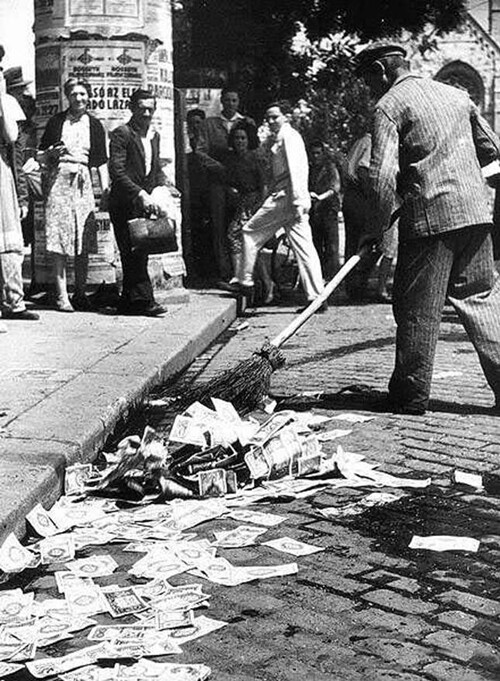
Indeed, I don’t think any kind of currency has intrinsic value apart from what it is made from. In a way, a banknote is only a kind of symbol representing a certain amount of generally accepted value. And that value can change horrendously if a nation is mismanaged, as has been witnessed by hyper-inflation in many countries.
I think this photo from post-war Hungary tells it all…
The same has been witnessed in Germany, old Yugoslavia and several African countries as well.
Such extreme situations are certainly not so likely nowadays with modern central banking practices, but like you say, in the event of SHTF, well…
Good point! In fact my country (and I am sure many others) publishes a list of things that households should keep a store of in case of emergency situations, such as bottled water, tinned food, spare batteries, etc - and a supply of traditional cash! Very sensible. Although I suspect that in the event of such a catastrophic situation, that money would not go very far because inflation would become rampant. That is what happened in recent Gaza.
That was indeed a horrific wake-up call! I couldn’t believe how fragile the entire global network really is!
Absolutely, it’s a question of perception. And, of course, when there is a constant and wide series of on-going, visible transactions then it is easy to see what a banknote can actually buy and confirms a level of value. We don’t actually see that with crypto yet and that places even more uncertainty about what it is worth…
For me, Bitcoin is not a full currency yet, but it already behaves like one in terms of global liquidity and price discovery. In trading I treat BTC as an asset with monetary properties, not as “digital cash.” The internet dependency argument makes sense — if infrastructure collapses, crypto collapses with it. But in a functioning world, the fact that Bitcoin doesn’t need a central authority and still holds value purely through consensus is exactly what makes it unique. Fiat survives because of trust in governments; Bitcoin survives because of trust in math and code. Different forms of the same idea.
Nice post, @Paul_J7, thank you for those thoughts.
I think that, at least during its early years, these features also made BTC suitable for the transfer of funds that preferred to stay in the shadows! Especially the anonymity provided by encryption.
I remember reading that President Trump was concerned about this during his first presidency.
If BTC had just been a fancy piece of software without this feature then I doubt whether it would have got anywhere. Fortunately, BTC is becoming progressively more watched by the regulatory bodies such that President Trump is now keen to make the US the global capital of cryptocurrency!
I agree, anonymity and lack of central control definitely played a huge role in Bitcoin’s early adoption.
But what’s interesting now is how the narrative is shifting.
The irony is that Bitcoin stayed alive because it had no central authority, and now its growth is pushed by institutions trying to regulate it.
I don’t think the growing regulatory impact is going to impede the core decentralised nature and intention of Bitcoin. If anything, I think its target is around the portals where money enters and exits the BTC microcosm rather than managing and controlling its internal functions. But I don’t know much about this side of it at all! So all comments are very welcome!
I chose to start looking into BTC mainly through boredom with the usual forex/indices which nowadays, for better or worse, are all tainted with Trumpism. The attraction of now trading BTC is that one can attempt to succeed with it by only using 100% technical analysis. I have always wanted to test that idea but it is impossible to avoid at least some kind of underlying directional feel when trading forex/indices.
My personal underlying anticipation with BTC is that it is here to stay and will settle into certain sectors of the monetary environment as a payment method. However, a big part of the current BTC ownership is based on its digital asset role, the value of which is anticipated to continue rising in the future. And it is here that I think the test will come.
As has been said many times, there is no underlying instrument that one can compare BTC’s value with. It stands alone. And therein lies the wildcard!
In the history of money, BTC is still an infant, borne to the public only some 16 years ago in 2008/9. And only in recent times have the floodgates started to open up in ETF funds and CFD trading. Therefore it is no surprise that the value has risen enormously so far, albeit with a few ups and downs along the way.
But these semi-dormant funds are only there in anticipation of rising value. There are no interim interest or dividend earnings as with bonds and stocks, etc.
So there will come a time when the inflow of new funds subsides together with existing funds withdrawing profits. I could then see BTC topping out amidst some vicious volatile swings, and finally settling into a narrow price range that no longer moves, simply because there is no longer any incentive to invest funds in an asset that has no prospect of capital gains in value.
Neither does Gold provide any interest or dividend income but it is a tangible, quantifiable asset that has stood the test of time over thousands of years.
I don’t see BTC ever achieving that - it will just become a rather boring digital asset used for transferring value and making payments. The question is, though, how long before this happens - and at what level!!!
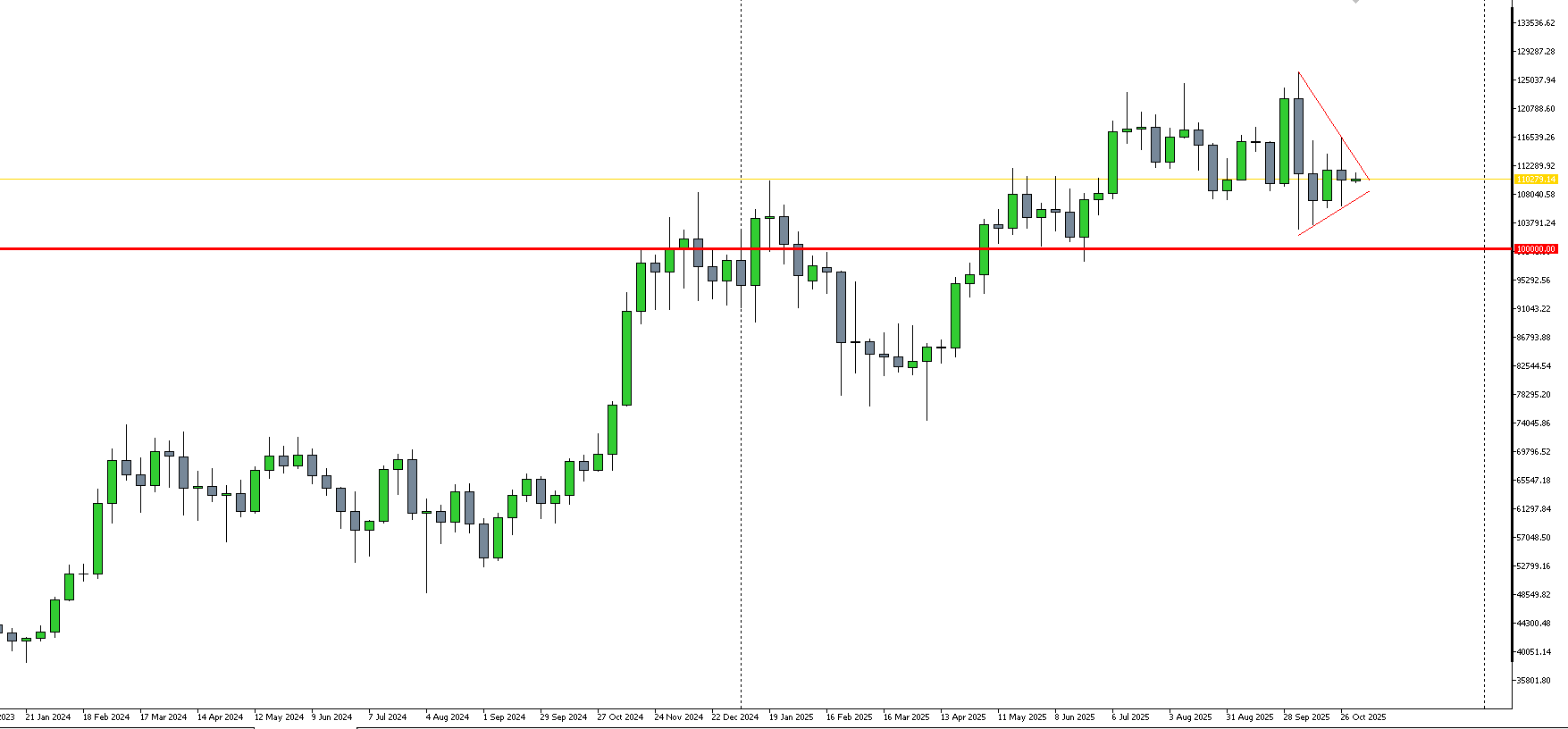
Weekend trading 1-2.11. has continued directionless and in a narrow range (fairly typical over weekends).
This weekly chart shows the price over this weekend and for the start of the new month. It is clearly still sitting near the centre of the range that has dominated October.
My short term charts are still showing neutral with the slightest whiff of downside bias, but nothing to make any directional decisions on - yet.
That psychological level at $100,000 is still close enough to figure on the downside - and the recent ATH at $126,000+ is similarly tempting a breakout on the upside…
I don’t understand @SmallPaul. I am not a bright guy but is there something missing here? like maybe a U-tube or something? If not, then where is the answer you are referring to?
Apologies if I am being exceptionally dumb here!
Here in the United States, I cannot pay my mortgage or rent, pay my gas bill, electric bill, water bill, taxes, restaurant bill, movies, buy a car, or purchase other goods and services using cryptocurrency. Even if it were accepted, there would be other businesses or countries that would require payment in fiat currency.
You will eventually have to convert cryptocurrencies to fiat currency.
I don’t think that is 100% true as long as BTC is still around. No one is claiming, or wondering, whether BTC will be the ONLY currency in existence, just another currency that works alongside fiat and other crpyto currencies.
Of course there will be currency conversions, just like there is amongst all the fiat currencies now.
But, as you say, the real question is whether one will be able to buy everyday products and pay everyday bills with BTC - and I think we are really moving towards that. Many companies already accept BTC and I think even in the US. (afterall, President Trump wants to make the US into the Crypto centre of the world…
Just a couple of quick googles seem to back up the spending width of BTC even now:
There is no single “crypto centre of the world,” but several cities are considered major hubs due to factors like regulatory clarity, a strong startup ecosystem, and crypto-friendly banking. Zug, Switzerland, is frequently cited as a top hub for its regulatory environment and is the birthplace of Ethereum
Key crypto hubs
Zug, Switzerland: Often called the “Crypto Valley,” it’s praised for regulatory clarity, crypto-friendly banks, a lively job market, and being the birthplace of the Ethereum cryptocurrency.
London, UK: Identified as a leading hub with a strong financial infrastructure and a large number of crypto-based jobs and companies.
Dubai, UAE: A major global crypto hub that receives significant crypto transactions and offers a 0% capital gains tax.
Singapore: Recognized as a digital hub for emerging technologies like digital assets.
Silicon Valley: A leading cryptocurrency investment hub, known for its technology and startup ecosystem.
Certainly, I agree that it would surely be a contradiction in terms to assume there could be a sole “crypto centre of the world”. But you know how Mr Trump talks about things
From Wikipedia:
“In President Donald Trump’s first term, he had opposed cryptocurrency, calling it “not money” and "based on thin air”. He had told Fox Business in 2021 that Bitcoin “seems like a scam” to compete with the U.S. dollar."
During the second presidency of Donald Trump, cryptocurrency was promoted by Trump and his administration, which took a series of crypto-friendly actions and decisions. His administration appointed crypto-friendly regulators, reduced crypto regulation and dropped investigations into crypto firms and crypto crime. Trump promoted his own cryptocurrency meme coin, $Trump, and maintained significant investments in crypto with his family company World Liberty Financial, all of which raised significant conflict of interest concerns. His campaign and inauguration received millions of dollars in donations from the crypto industry, and he called himself the “crypto president”.
The claim that America will be the crypto center of the world is based on current administration policies that aim to foster crypto innovation and adoption through legislation like the GENIUS Act and a supportive regulatory environment. This policy shift is intended to attract investment, create clear rules for digital assets like stablecoins, and position the U.S. as a leader in the global digital finance market.
Key developments
Supportive legislation: President Trump signed the GENIUS Act into law, which provides regulatory clarity for stablecoins, a specific segment of the crypto market. The act is expected to make stablecoins more accessible for everyday transactions and allow financial institutions to issue them with greater confidence
Pro-innovation policy:
The administration has ended aggressive enforcement actions against crypto companies and has pledged to create a more favorable regulatory climate for digital assets, according to The White House and U.S. Department of the Treasury.
Leadership and strategy:
The administration has appointed a “AI and Crypto Czar,” David Sacks, to help lead the effort. A Presidential Working Group on Digital Asset Markets was also formed to operationalize the goal of making the U.S. the “crypto capital of the world,” as stated by the White House.
Market response:
These developments have been met with enthusiasm in the crypto sector, with the overall market valuation of cryptocurrencies hitting a record $4 trillion shortly after the GENIUS Act vote.
Broader context
Bitcoin holdings: The United States has a large amount of Bitcoin, holding the highest amount of any country in the world, valued at about ($16.7) billion.
Central Bank Digital Currency (CBDC): President Trump has stated his opposition to a central bank digital currency in America, emphasizing the importance of private sector innovation in digital finance.
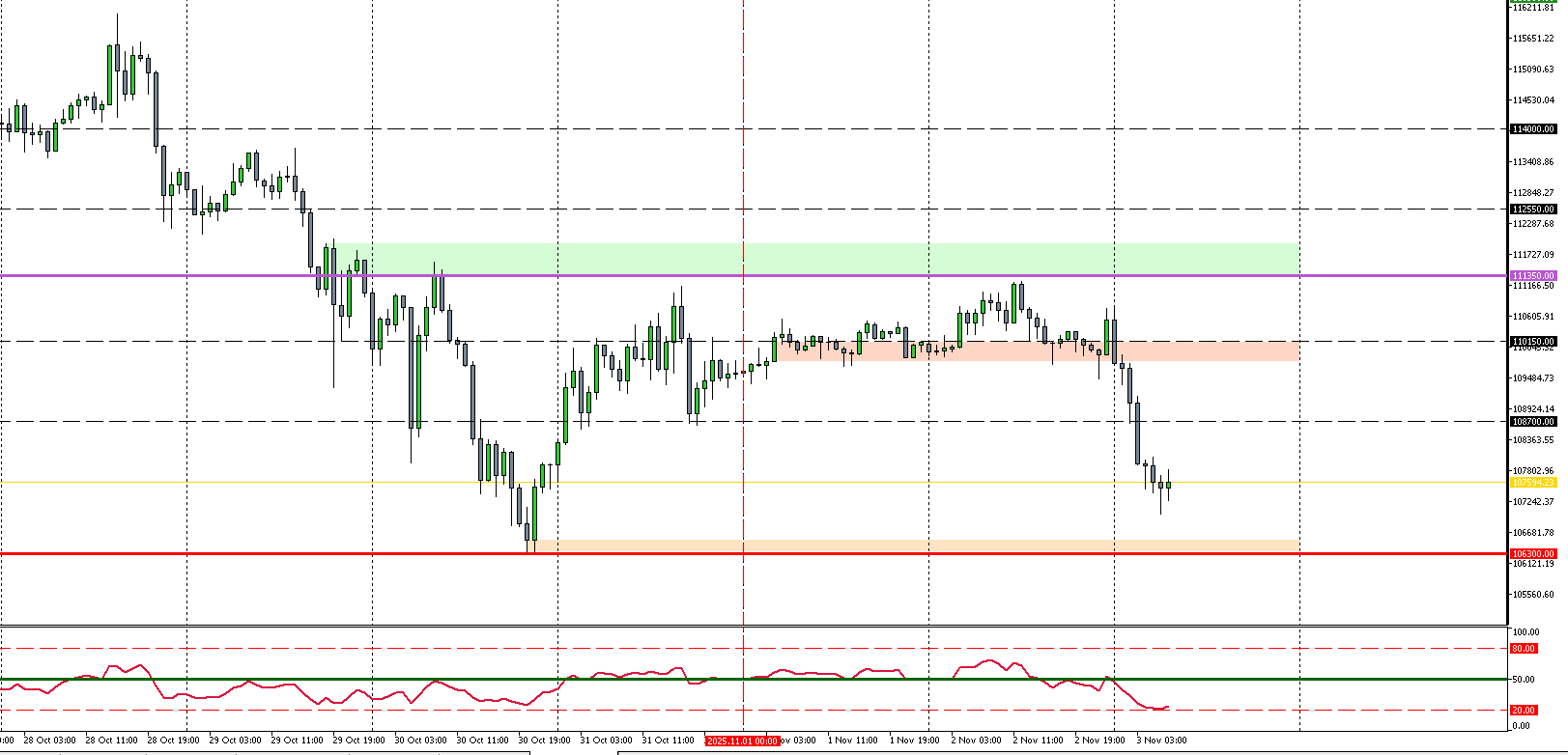
Last night (Sunday) I said there seemed a slight downside bias. The level I was watching on this hourly chart was triggered at 4 o’clock this morning!!! And not just any morning, but a Monday morning!!
So I sold it and bought it back when I got up for breakfast - a nice start to the coming week. Earning while sleeping - can’t be bad!
But I have noticed that there is often a move in the Far East, which is certainly not good for my sleep patterns!
But that is all part of this experiment in trading BTC strictly and purely off TA. In other words, does TA really work!
I only really started this seriously at the beginning of last month, October, when I decided to dedicate a funded prop firm acct to BTC alone. October went well with a win rate of 75%.
The unique advantage in using BTC for this experiment is that one can take a useful and educational interest in crypto development without, at the same time, forming an opinion on near-term direction that can (and does) bias the TA.