Gold has been a source and measure of value for thousands of years.
a form of paper money first appeared in China in the 7th century in the form of promissory notes between merchants
The first official government-issued paper money emerged in China around the 11th century
Bitcoin was born in 2008-9
Bitcoin is just digital coding and does not physically exist and has no intrinsic value of its own beyond supply and demand.
But nowadays paper money is also very much digital and the use of actual physical banknotes is diminishing.
Since the end of the Bretton Woods system paper money has no intrinsic value of its own either as witnessed during the periods of hyper-inflation such as in post-war Hungary. for example.
Bitcoin and other cryptocurrencies are young and still working their way through their teething problems and no one is sure yet what their role will be in the future - or what their value will be based on.
There are major differences between gold, paper (fiat) money, and cryptocurrencies. But we can say that gold is no longer used as a form of daily financial transactions and we can say that physical banknotes are also disappearing from daily use.
So does that leave Bitcoin as the flagship in a new ascending order of payment mechanisms?
I used to find trading BTCUSD to be about the most boring activity ever invented on this planet, and the use of it to be primarily the domain of transactions that shun the light of day.
But I think this is changing fast nowadays and BTCUSD is maturing into a viable and interesting “forex” market - albeit with its own interesting characteristics…
This is not a thread about trading BTC, but its value and direction is a core issue underlying its other points of interest. So this thread is just about Bitcoin, and what makes it interesting - or not! Whatever!
The U.S., U.K., and many EU countries allow Bitcoin use but impose regulatory measures. Some countries, like China and Saudi Arabia, have banned Bitcoin due to its decentralized nature. Cryptocurrency regulations are evolving, with many nations updating laws as the market matures.
Countries Where People Can Legally Use Bitcoin.
In countries where cryptocurrency is legal, companies can accept Bitcoin as a form of payment for goods and services. Some use it for cross-border transactions, others integrate it into checkout systems through licensed providers.
Most transactions are subject to standard compliance rules: identity checks, transaction monitoring, tax reporting. Bitcoin is usually treated as a digital asset, not currency, but legal use still opens options for businesses working in international markets.
Below is a list of jurisdictions where crypto payments are legally permitted and used in commercial settings.
El Salvador
El Salvador is one of the first two countries in the world that have accepted Bitcoin as legal tender. The Congress of El Salvador approved a bill by President Bukele back in 2021. The bill officially announced that the cryptocurrency will become a legal form of value exchange and made it possible for everyday citizens to purchase goods and services with crypto under a national legal framework for digital currencies.
The Central African Republic
Only two countries in the world recognise Bitcoin as genuine legal tender. The first is El Salvador. The second is the Central African Republic. It adopted Bitcoin as legal tender in the second quarter of 2022, following a shift in government policy aimed at broader crypto recognition within the national economy.
The United States
In the United States, individuals and businesses that store or exchange Bitcoin fall under the category of an MSB — money services business. All MSBs are subject to the Bank Secrecy Act and related AML laws.
The Treasury has defined Bitcoin as an exchangeable currency that can act as a substitute for real money. Additional crypto legislation applies when investigating illicit activity or financial misconduct linked to digital assets, but individuals and businesses are free to use cryptocurrencies for payments.
United Kingdom
In the UK, Bitcoin is not legal tender. Still, using it for payments is allowed. Companies can accept crypto if they follow registration rules and meet financial reporting standards.
Bitcoin is treated as a digital asset and taxed under existing laws. The UK is not on the list of bitcoin legal tender countries, but it remains one of the crypto legal countries with a defined legal position.
The government sets rules through a formal regulatory framework, focusing on compliance and transparency in crypto-related activity.
The European Union
The EU believes that tokens are a class of assets and does not consider their use illegal.
The European Union has a complex stance on cryptocurrencies, but many EU countries have taken steps to improve token regulation. Some countries, such as Belgium, Finland, and Bulgaria, have introduced legislation on the use of cryptocurrencies.
The European Banking Authority has warned about the risks associated with crypto assets and is not in control of crypto asset activities. In 2022, the EU proposed legislation on crypto enforcement and investment rules for digital assets.
Canada
In Canada, cryptocurrencies are considered a commodity for tax purposes. Crypto exchanges are classified as money service businesses.
The Canadian government has strict laws and regulations in place to prevent money laundering and terrorist financing through the use of crypto. As long as users meet crypto compliance requirements, they are free to use and trade cryptocurrencies in Canada.
Israel
Israel is open to the use of cryptocurrencies, with many crypto ATMs and merchants throughout the country accepting Bitcoin as payment. It is one of the bitcoin accepted countries, with growing adoption in retail.
Tax authorities in Israel do not currently consider Bitcoin to be a currency, security, or asset. However, a 25% crypto taxation applies when a seller sells Bitcoin.
Australia
Australia’s stance is similar to that of Canada. Australian authorities consider cryptocurrencies to be digital assets with a value that can be taxed. This classification defines the tax treatment of crypto transactions.
If someone buys, sells, gifts, or converts crypto into fiat for purchases, it triggers a capital gains event. However, if crypto is held without active trading, tax is not usually applied.
In Australia, you’re also required to keep records of your transactions, although wallets and exchanges often handle this. The trading legality is well defined, but users are expected to stay compliant with reporting rules.
The maximum number of Bitcoins that can be created is 21 million (or very near to that). This maximum was built into the original protocol for Bitcoin (partly) to create a scarcity value.
Already over 19 million Bitcoins have been created (mined) and it is estimated that the maximum will be reached around 2040.
Browsing through these matters it reminded me that one of the security issues with BTC is its anonymity. But the downside of this is that if you lose or forget your wallet password then your BTC is lost forever…
Thinking about the scarcity issue with BTC, I wondered if there is any info on how many BTC have, indeed, been lost so far…
A quick google produced this, rather surprising, result:
" As of 2025, an estimated 2.3 to 4 million BTC, or about 11 to 18 percent of Bitcoin’s 21 million cap, are believed to be permanently lost."
Up to 20% of BTC no longer in the market!!! In spite of the talk about scarcity of BTC, this point is rarely raised. But what a factor!!
In fact, in addition to these lost Bitcoins, nearly one million coins are held by the founder “entity” of BTC. Satoshi Nakamoto, which are held in some 20,000 addresses and have remained effectively untouched. So are these active or passive coins in terms of availability?
What this does do is raise the question: Does it really matter how many BTC there are, and to whom?
Who needs to own the “real thing” when there are effectively limitless “shadow” pseudo-coins like ETFs, CFDs and BTC futures and options which reflect the same price?
I am sure there are more “digital” dollars in bank accounts, etc, than exist in actual physical banknotes so what is the difference? If there is a market then there is a price and the price is the result of supply/demand, sentiment, trust, and other related markets, etc.
A maximum of 21 million (less maybe 5 mill lost or passive)? Interesting, but maybe not so relevant to how I trade it today…
This is an interesting comment. One can ponder whether Bitcoin is a real currency or just a modern, sophisticated commodity that is used in barter trade just like squirrel skins in days gone by…
Ah, but is it really? Or is it just our trained conception that a banknote is a tangible currency unit?
For example:
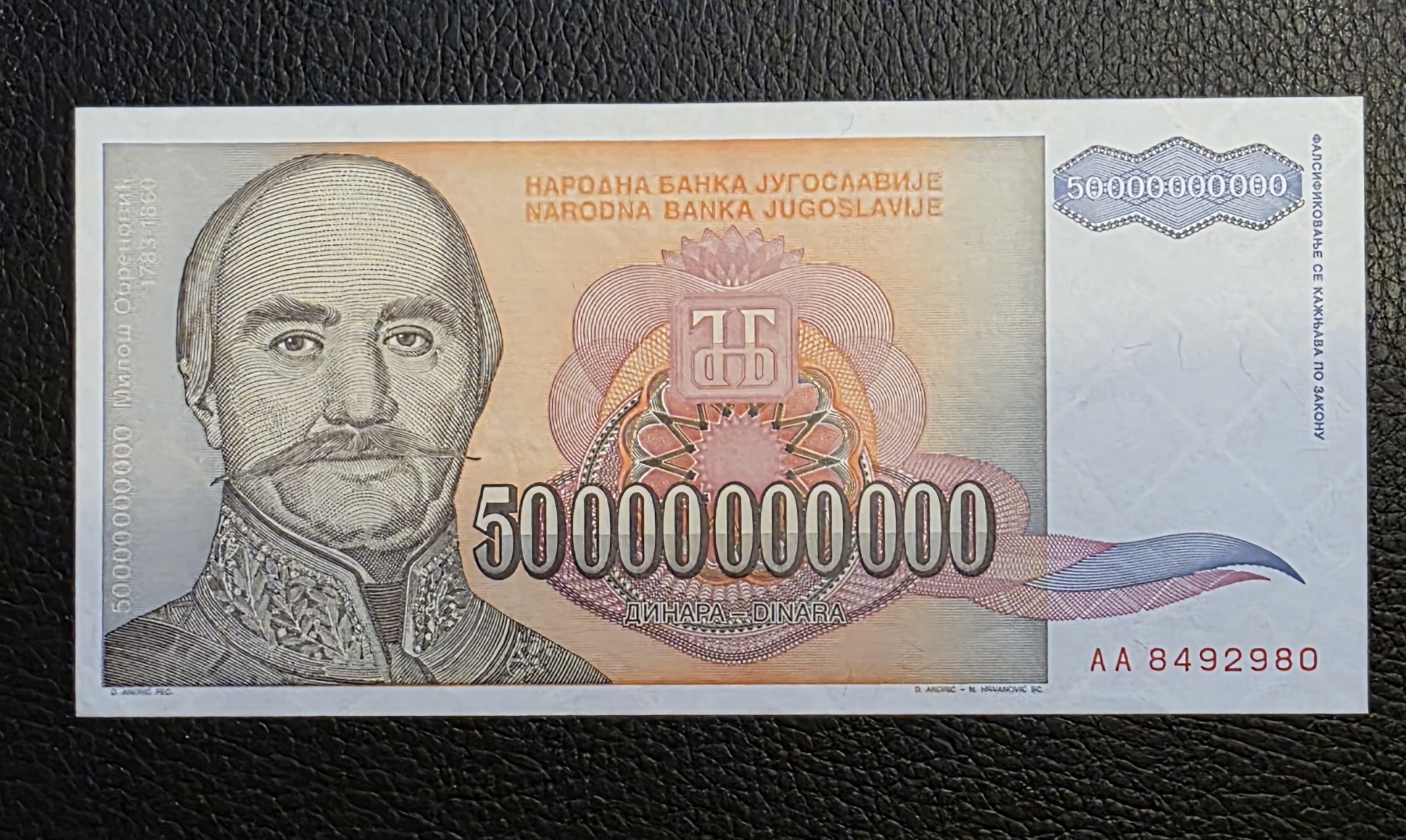
Here is a brand new condition 1993 Yugoslavian tangible banknote. Its denomination is for no less than 50 000 000 000 dinara!!! Its actual value today? Maybe around 5€…
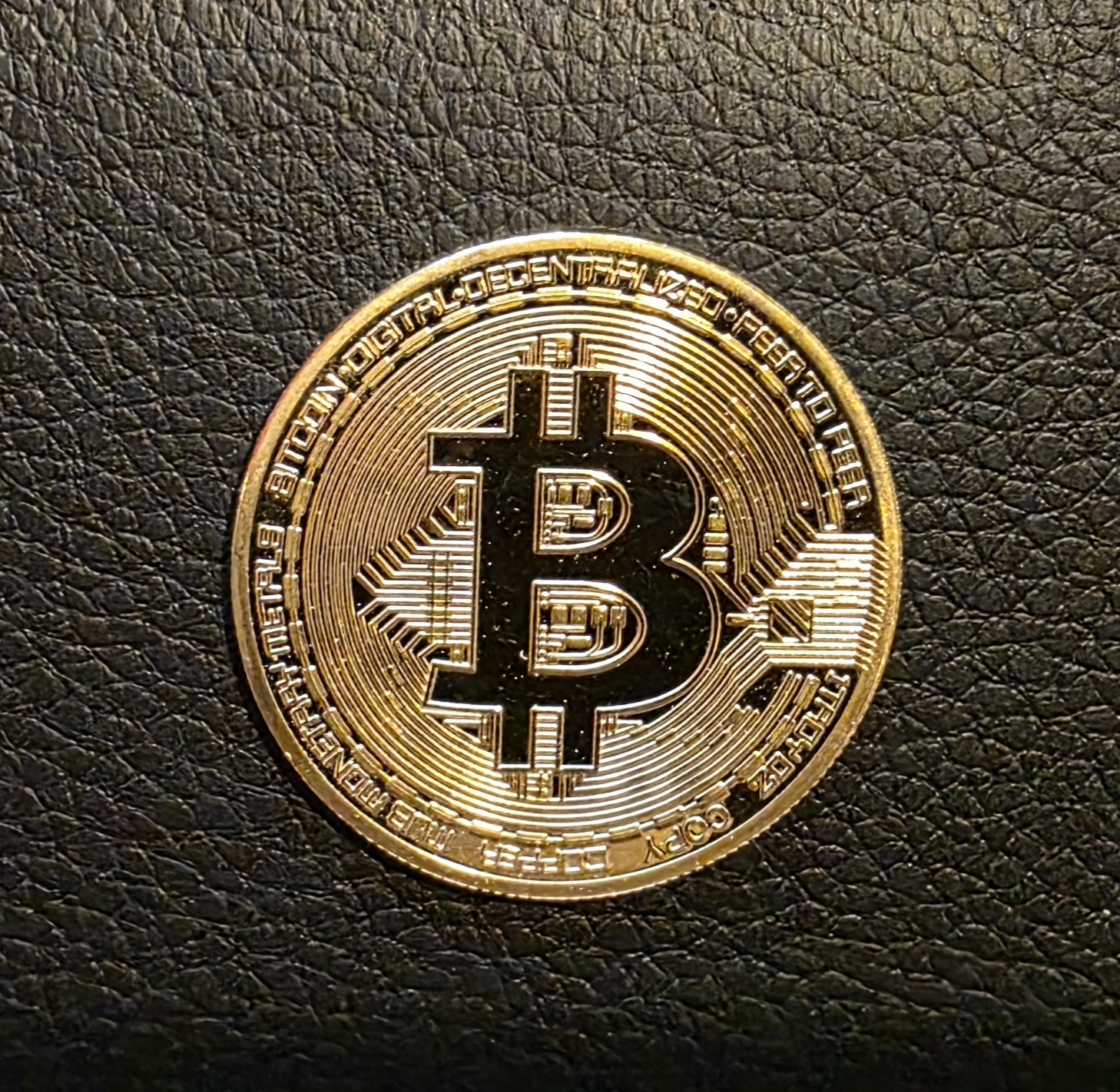
Here is a brand new condition 2025 Bitcoin tangible token. Its denomination is for one Bitcoin. The current value of Bitcoin is around $113 000. What is the actual value of the token? Maybe around 1€ from an online shop…
So what is the difference? Tangible versus intangible? What this says to me is that all currency is actually intangible in terms of value. Whether it is a dollar or a pound or a Euro or a Yen, etc. The value is not in the paper at all, it is in the minds of those transferring its ownership and is based on a lot of other intangible factors like interest rates, economic projections, risk perceptions, inflation expectations, etc.
And on top of all that, as said earlier, we don’t even actually use the tangible paper varieties so much any more. So the question really becomes, how do we perceive value whether it is a fiat currency or a commodity type currency like Bitcoin or Gold?
BTC has been sluggish in recent days, which in most comments that I’ve seen has been put down to worries over Fed comments (re forthcoming rate cuts) and the US-China trade talks.
If BTC were a “normal” currency then one could understand this as a normal market concern. But why should these factors affect a crypto currency at all…
This was one comment that caught my eye:
"U.S.-China trade ructions have little direct impact on the crypto industry. But a shift in market sentiment tends to drag prices along, with Bitcoin’s flash crash in early-October stemming chiefly from resurgent U.S.-China trade tensions. "
So do economic factors affect crypto or not? I think the most appropriate answer to this question is “yes, no, and don’t know”.
Since BTC is not in any way a currency widely used for commercial trade transactions then I would suggest economic data is of little direct consequence. However, the reality is that it does! So what does it follow? and why?
But since the majority of BTC holdings are investments for longer-term gains then there is possibly an element of comparative investment where funds are moved from one investment source to another. This is maybe a growing influence due to the increasing institutional addition of crypto to their portfolios. But, on the other hand, this is not an intraday, every day, event.
There are, of course, specifically crypto-related issues and events that certainly do impact price such as regulatory factors, taxation practices, and permissions, etc. But, again, these are not intraday, every day, factors.
However, the more I watch price movements on BTC, the more I feel the key mover is nothing more than pure sentiment based on a solid underlying belief that BTC will continue to rise and that price retracements are nothing more than buying opportunities - until or unless, that is, this underlying belief stalls and cracks appear. If that should ever happen, then the fall will be hard and horrendous. So that is a very big “if”… But the more institutions become involved with large sums, and the more governments accept crypto, the more concerned and active the monetary authorities will become in avoiding such an outcome…
I am flat at the moment, its been a good month for trading short term (4H/1H/15m charts). Could be a volatile but directionless couple of days into the weekend as the details filter through on the US-China agreements…
Generally speaking this is true. But there are already a few countries that have accepted BTC as an official currency and, as you say, this is likely to increase in the future (for example, see the article posted by @SmallPaul above) .
This is also an interesting page regarding predictions of future acceptance:
BTC had another weak day yesterday in an overall weak week! There are a number of commentaries here and there trying to explain why, especially in the face of otherwise good news like reduced rates in the US and a good outcome to the US-China meet. For example, its (apparenty!) because Jerome Powell was vague about further cuts in December!
But Mr Powell clearly said this was because of an unclear situation regarding inflation and the jobs market because there is little current data available due to the continuing US shutdown…
So, again, I ask myself, what on earth are these guys driveling about? BTC is not tied to inflation expectations like interest rates, it is not tied to employment levels like fiat currencies, it is not tied to risk on/off like Gold…
Everyone seems to apply the normal, traditional, fundamental analytics to BTC in the same way as they do with other, concrete, currencies, indices, and commodities. And it doesn’t fit…
You cannot find the right gloves to fit the BTC hands nor the right shoes to fit the BTC feet…why? because BTC doesn’t have any hands or feet…in fact, it doesn’t have anything that you can hang your hat on.
Or is that actually true? Well, no, it isn’t. BTC does have one peg to “analyse”, and, in my opinion, only one - supply/demand imbalance. Trouble is for commentators, there is so little to write an article about supply and demand that they wouldn’t keep their jobs if they don’t fancy it up a bit by linking it with all the typical economic “cause and effect” that we love to read and lean on (and maybe blame when it’s wrong! )
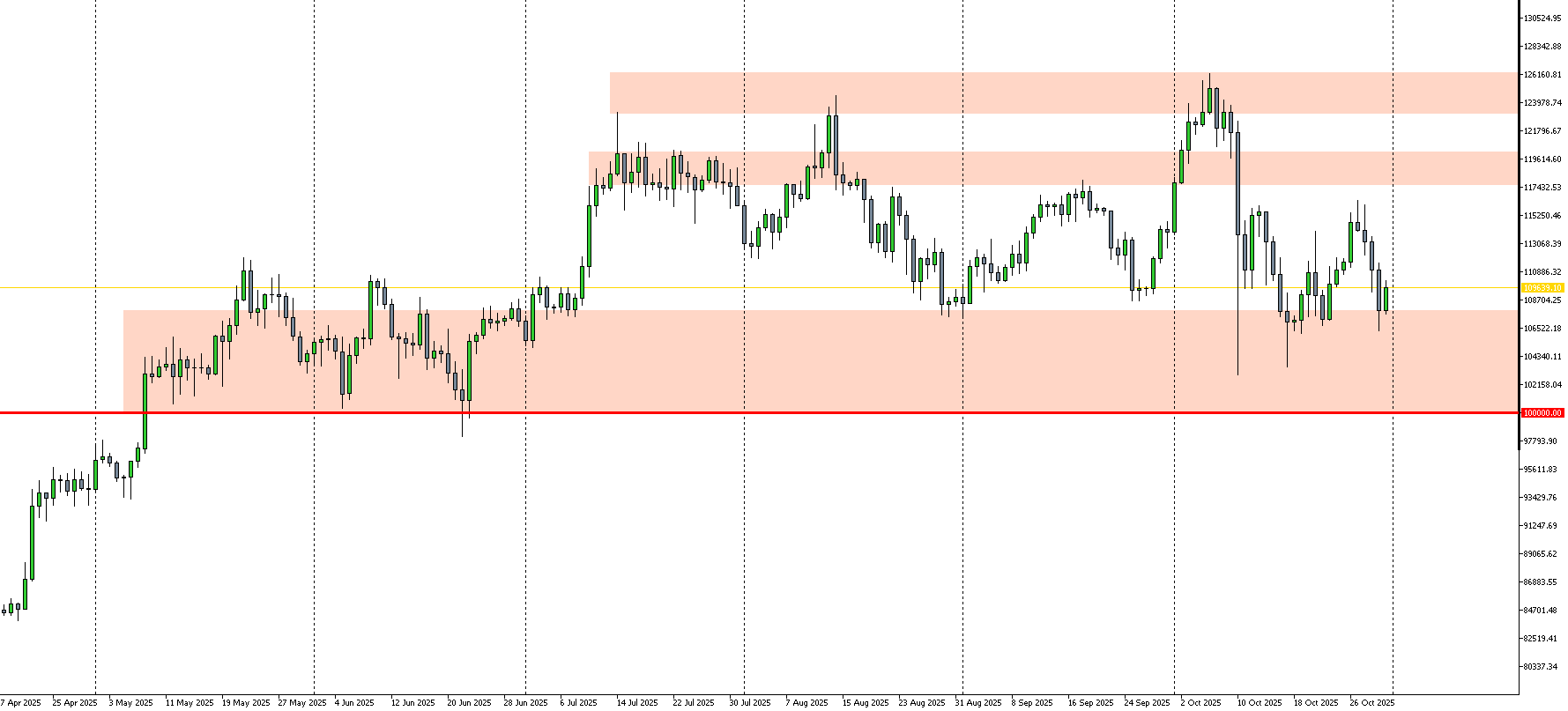
So, ok, what can we say about supply and demand? Well, here is a daily chart going back to last spring after a long, strong ride up.
What this tells me is that BTC has been in a very broad and directionless range since the spring when it once again broke above $100,000. Sure, it has made several new highs but these were the results of a few spikes rather than any underlying trend - just a broadening of the range, effectively…
But if we look at the October end then it is struggling (and no, I don’t know why ) Every brave attempt higher is met with selling. ETF funds, etc, are reporting smaller inflows in BTC. So what can we expect?
I treat BTC like an index or commodity and tend to mainly only buy and hold until the next signal. But I can’t keep my eyes off that core baseline at $100,000. That is such a strong psychological level, almost magnetic, especially after only recently making new ATH’s, and has held a few times already.
So is the market drawn towards this level just because it is on the radar again? Or will we see strong buying starting to come in on any more dips? Although it has been a negative week, we haven’t dropped yet below last week’s low point. So it is not that negative - yet?
Personally, its day trading only for the next week, in both directions, I think…
I have to add one more comment about that daily chart and the $100,000 level.
Now that it is nearby and in everyone’s focal lenses we could add that $100,000 is also the 50-week moving average. We broke above that level about one year ago and revisited it, and bounced off it, earlier this year around Feb/Mar. We had been in an uptrend since then, which has pretty much now stalled…
So this is a big number, both psychologically and technically. If we drop through that then we are looking a long way down…
On the other hand we may well bounce away from it and all the happy bunnies can then wipe the sweat from their foreheads, load their wheelbarrows to the brim, and take a long holiday…
Bitcoin whales??? I had never heard of this before. It refers to the big owners of actual Bitcoin. According to AI, the definition and relevance of a Bitcoin whale is:
A bitcoin whale is an individual or entity that holds a large enough amount of bitcoin to significantly influence the market price when they make a large trade. While there is no strict minimum, holding at least 1,000 BTC is often cited as a benchmark, and their massive transactions can cause price volatility and affect market sentiment.
This is big! You don’t hear this kind of definition in fiat markets! I am reading more about these whales and their activities and will come back to this.
So we finished October. A month that was quite pessimistic and uncertainty reigned. Even yesterday price action looked like it might give way at any moment but actually the selling dried up and we have risen slightly off the lows this morning (yeah, great isn’t it, BTC never sleeps, the market is always there, moving, 24/7. I like that, I must be an addict…) - I wonder on what day does the week start? Does it end Fri evening and start Sat morning? Or end Sun night and start Mon morning?
But how are we left? Well, according to my analysis the shorter term is starting to show some neutral to positive signs but there is still a grey Halloween cloud overhanging the daily and 4H charts. My only activity was a small short that reversed and lost money and a small long that made it back again. Both off the 15 min chart, which I really don’t like trading. I.e. trading noise and not “whales”
So November starts with a status of “Neutral”. Which, according to another thread nearby, means either you take any position and see what happens or you do nothing. I prefer nothing, its easier on the mind!
Who are the whales?
This leads me, as an ignorant Bitcoin sceptic, to conspiracy theories and ponzi schemes.
Here is an AI view of Tulip mania -
The collapse of tulip mania was caused by the inevitable bursting of a speculative bubble, triggered when prices became detached from any rational value, leading to panic selling. When a small number of speculators began selling, it caused others to panic and sell their holdings, leading to a rapid and dramatic price collapse. Contributing factors included growing doubts about the inflated prices, the market reaching its saturation point as buyers ran out, and the unsustainable nature of the market itself.
Growing doubts and market saturation: As prices reached exorbitant levels, people began to question if the bulbs were worth the cost, and the number of potential buyers dwindled. Eventually, the market ran out of new buyers to sustain the price increases.
Panic selling: The first wave of selling caused panic among other holders, who feared losing their entire investment. This created a domino effect where everyone rushed to sell at once, driving prices down even further.
Unsustainable market: The speculative bubble was built on the expectation of ever-increasing prices, with no relation to the actual utility of the bulbs. This created an inherently unstable market that was bound to collapse once confidence wavered.
Government intervention: The Dutch government eventually intervened to nullify contracts, which allowed many speculators to back out of their inflated purchases and further destabilized the market.
I most certainly agree that the risk of a major collapse at some point is a concrete risk that people should be aware of. The main problem is, as mentioned earlier, there is no substance underlying Bitcoin (or any other crypto) against which one can assess its “proper” value.
Its price is purely the balance point between buyers and sellers, that’s all. And if we add to that how high prices have risen in only a few years, since 2009. then there is just cause to question its sustainability. For example, if one had invested $1000 in Bitcoin in 2015, it would now be worth close to half a million dollars.
However, there is another side to it. Bitcoin is not just a passive digital entity. It’s attraction lies in its cross-border decentralised and anonymous means of transferring wealth and payment transactions. This, of course, is not necessarily always a “good” thing and it is hard to track where money is going to and from!
But the more it becomes under the regulatory authorities eyes and accepted as an official currency by governments, the less likely it is to collapse completely.
But even if BTC continues and expands as a monetary instrument, there is still the issue of what is its “correct” value.
I don’t doubt for a minute that there will be turbulent times - isn’t there in everything nowadays! But I am inclined to accept that BTC could just as easily become a “digital gold” hedge against inflation and economic depression as become the next “Tulip mania”
But… is this really a problem for us retail traders? I don’t think so if a trader is managing their account risk and exposure properly. If stops are in place then one could get a large negative slippage in a fast market but that’s about it.
The beauty of trading cfd’s and futures is that one can change positions very fast and cheaply compared with wallet contents. And a 24/7 market only helps facilitate that flexibility.
So I am not, personally, worried about a collapse. If it happens I would expect to soon be on the same side as the move!!!
I would also add that if a trader is seriously worried about a major collapse then it is worth trading BTC like I am doing, i.e. buy a prop firm account and trade their money. The most you can lose is the cost of the account and any undrawn profit share at the time. Naturally, the prop firm itself is another risk on top of BTC itself, but I think we are all used to the “broker” factor.